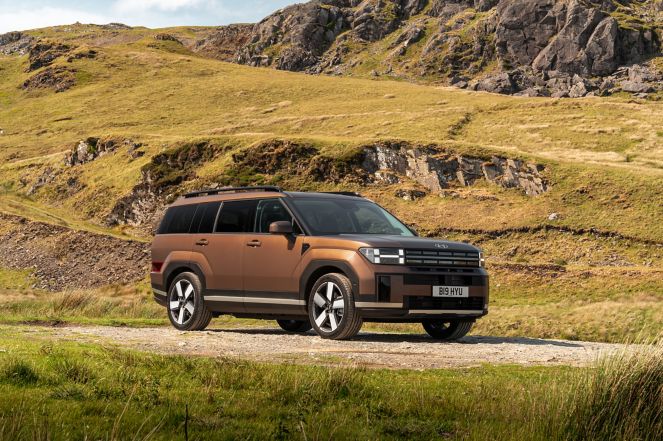
The fifth-generation Hyundai Santa Fe is one of the most convincing seven-seat family SUVs because the boxy shape is not just styling, it creates genuinely useful passenger and luggage space. The 215PS self-charging hybrid is the version I would start with, unless regular charging makes the PHEV's extra complexity genuinely worthwhile.
The Santa Fe looks dramatically different from the car it replaced, and for once the upright styling serves a real practical purpose. A nearly vertical tail, long wheelbase and tall roof make it much easier to package people and luggage, while the broad tailgate creates the sort of opening that makes loading family equipment less of a puzzle.
Design and first impressions
The new Santa Fe is deliberately square, with strong horizontal lines, pixel-style lighting and a stance that feels much closer to a large American SUV than the softer shape of the previous model. It is not subtle, but I think the design works because it reflects what the car is trying to do: carry a lot of people and their belongings without apologising for the space that requires.
At 4,830mm long and 1,900mm wide before mirrors, it is a substantial vehicle. That size is why the cabin is so useful, but anyone with a narrow drive, older garage or city-centre parking routine should measure first rather than assume cameras and sensors will make every space effortless.
Inside the cabin
The interior feels far more upmarket than older Santa Fes, with a broad digital display, clean dashboard and plenty of storage. Hyundai has also thought carefully about how a family actually uses a large SUV, with wide-opening doors, multiple charging points and a cabin that feels designed around carrying people rather than simply impressing them.
I would still prioritise seat comfort, access to the third row and visibility over the technology. A seven-seat SUV succeeds through hundreds of small interactions, such as helping a child into the back row or loading a suitcase without folding half the cabin, and the Santa Fe's design appears to take those details seriously.
Seven-seat practicality
The third row is the reason to buy this car. Hyundai's European data gives the seven-seat hybrid 628 litres in its luggage measurement with the third row folded and up to 1,949 litres with the rear seats down. With all seven seats in use, luggage space is naturally much smaller, so a family that regularly travels seven-up should check whether there is enough room for everyone's bags as well as the passengers.
The 2,815mm wheelbase and square roof make the third row more usable than the emergency seats found in some nominal seven-seaters. I would still take the people who will actually use those seats to the viewing because no specification sheet can tell you whether access and legroom work for your family.
Hybrid or plug-in hybrid?
The UK launch range centred on a 215PS self-charging hybrid in front- or four-wheel-drive form and a 253PS plug-in hybrid with four-wheel drive. The entry 2WD hybrid produces 367Nm and reaches 62mph in 9.6 seconds, which is adequate rather than fast.
I would choose the ordinary hybrid for mixed family use unless you have dependable home or workplace charging and can make meaningful use of the PHEV's battery. A plug-in only delivers its best running-cost case when it spends a lot of time charged rather than carrying extra battery mass on petrol power.
Road manners and refinement
I have not driven this particular Santa Fe, so I would not present launch-test impressions as my own. The consistent theme from independent reviews was that the car is comfortable, spacious and easy-going rather than remotely sporting, which is exactly what I would expect from a tall seven-seat SUV weighing close to two tonnes.
My test-drive priorities would be refinement when the engine is working hard, ride comfort with passengers aboard and the low-speed transition between electric and petrol operation. Those everyday details matter far more than whether the steering can be made artificially heavy through a drive-mode menu.
Pricing and which version makes sense
Premium Hybrid 2WD started at £46,775 in 2024, with Ultimate and Calligraphy moving beyond £50,000. That is a long way from the value-led Santa Fe many people remember, but the equipment, cabin design and seven-seat capability have moved significantly upmarket too.
I would start with Premium because Hyundai already included a substantial level of safety and convenience equipment. Higher trims look impressive, but a family SUV is often at its best when the money goes into the space and powertrain rather than cosmetic upgrades.
Leasing and alternatives
The Kia EV9 is a very different fully electric seven-seat alternative if charging is practical, while the Peugeot E-5008 offers another electric route to three-row family travel. The Dacia Bigster is substantially cheaper but only has five seats, which helps clarify whether you genuinely need the Santa Fe's extra row.
Verdict
The new Santa Fe is at its best when the family actually needs what its design provides. Seven proper seats, a broad tailgate and enormous flexibility are more persuasive than another premium badge or a slightly quicker acceleration figure.
I would start with the Premium 2WD hybrid, make sure the parking footprint works at home and then compare the current Rivervale lease against other genuine seven-seaters. If the third row will be used regularly, the Santa Fe's unapologetically boxy shape becomes a major advantage rather than merely a styling statement.