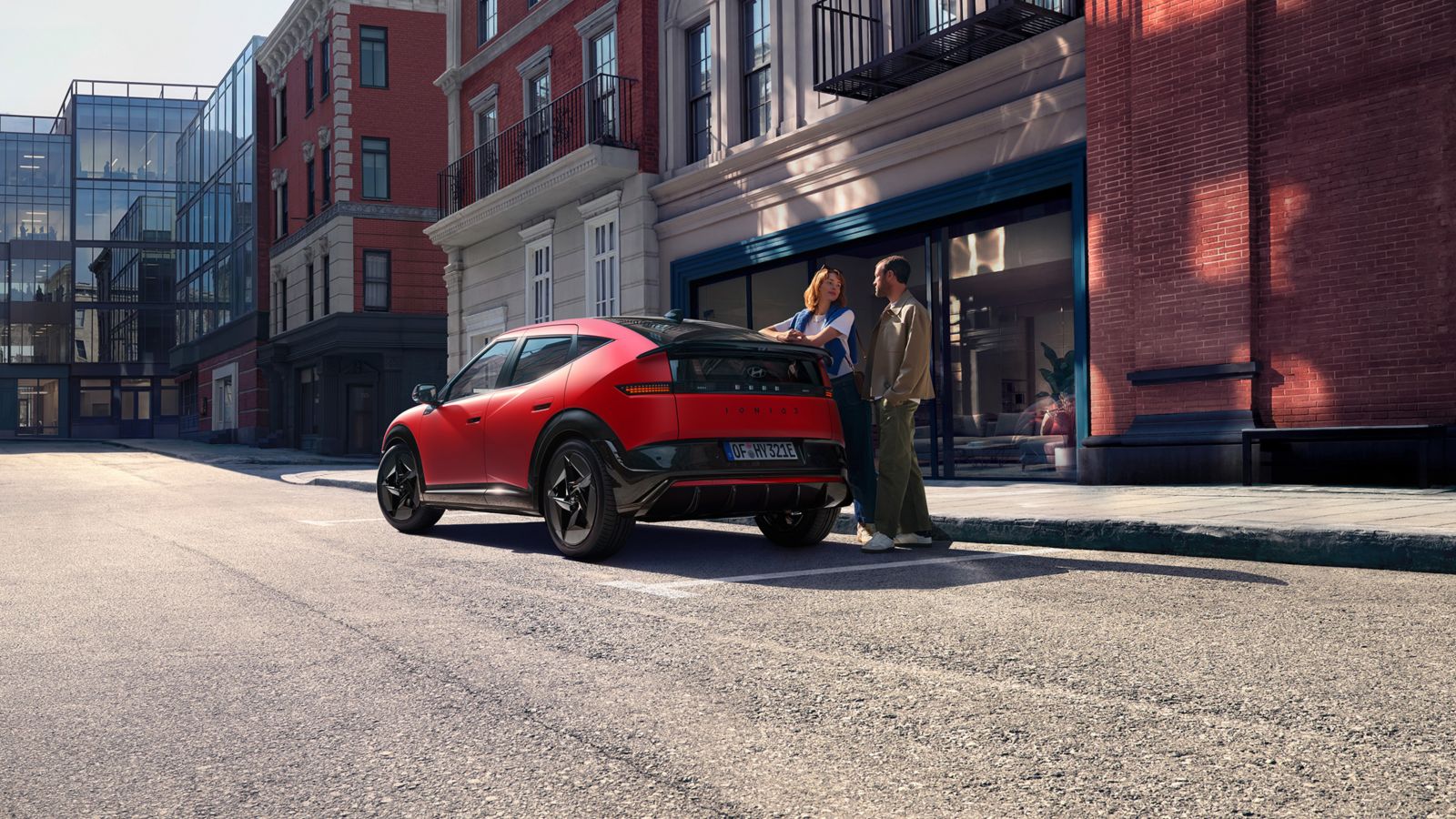
The New Cool Kid on the British Block
Remember the Hyundai of old? The cars you bought with your head, not your heart, usually because they came with a five-year warranty and were about as exciting as a wet Tuesday in Slough? Forget all that. Those days are deader than a 1980s disco. Following the smash hits that were the Ioniq 5 and 6 - cars that looked like they’d escaped from the set of a high-budget sci-fi flick - the Korean brand is aiming for the jugular of the European market with this: the Hyundai Ioniq 3. It is, essentially, a 'honey, I shrunk the Ioniq 5' moment, and frankly, it is exactly what the UK car market needs right now.
While the rest of the automotive world is obsessing over massive SUVs that are a nightmare to thread through a Sainsbury's multi-storey or park on a Victorian terrace, the Ioniq 3 is a compact, punchy hatchback. It’s aimed squarely at the fashion-conscious urbanite who wants electric efficiency without the 'fridge-freezer on wheels' aesthetic that plagues the lower end of the market. It’s a direct response to the Renault 5 E-Tech and the upcoming VW ID.2, and on first impressions, it’s brought a very large, pixelated stick to a knife fight. It feels like a turning point, not just for Hyundai, but for the idea of what a 'small car' can be in the 2020s.
Key Figures: The Vital Statistics
Before we dive into the textures of the dashboard, let's talk numbers. Our test car is the Ultimate trim, sitting atop the range with a price tag around the £34,000 mark, though the entry-level models start much closer to £28,000. Under the floor sits a 58kWh battery, which Hyundai claims will propel you for 270 miles on a single charge. Power goes to the rear wheels - hallelujah - delivering 168bhp and 258Nm of torque. That’s enough for a 0-62mph sprint of 7.8 seconds. It’s not going to win any drag races against a Tesla Model 3, but in the real world of 30mph limits and roundabout lunges, it’s more than enough. More importantly, it supports 150kW DC rapid charging, meaning a 10-80% top-up takes just 20 minutes. In the world of small EVs, that is a serious USP.
Design: A Pixel-Perfect Statement
Visually, the Ioniq 3 is a triumph. In a world of over-designed Chinese imports and safe, 'samey' German saloons, the Ioniq 3 stands out for all the right reasons. It retains those 'Parametric Pixel' lights we’ve come to love from its bigger siblings, but on this smaller frame, they look even more purposeful. It has a squat, wide stance that suggests a certain level of agility. It doesn't look like a traditional hatchback, nor does it look like a shrunken crossover. It’s just... cool. It’s the kind of car that makes you look back at it after you’ve locked it, which is the highest praise you can give any piece of industrial design.
The silhouette is reminiscent of a 1970s Lancia Delta mixed with something from a 16-bit video game. There are sharp creases in the doors, a distinctive 'V' shape to the front bumper, and a rear light bar that looks like a digital ticker tape. It manages to look futuristic and retro at the same time, a hell of a trick to pull off without looking gimmicky. The 19-inch wheels on our Ultimate trim fill the arches perfectly, though you do wonder what they’ll do to the ride quality on our crumbling British B-roads. But as a piece of kerbside theatre, the Ioniq 3 is currently unbeaten in its class.
The Cabin: 1970s Chic Meets 2026 Tech
Step inside, and you’d be forgiven for thinking you’d accidentally wandered into a high-end furniture boutique in Chelsea. Hyundai says the interior was inspired by 1970s lounge furniture, and you can see it in the textures and shapes. There are sustainable fabrics - recycled PET plastics and eco-processed leathers - that actually feel premium to the touch. They don't feel like the 'recycled cardboard' you get in some rivals; they feel like something you’d want a sofa made out of. It’s an airy, minimalist space that feels far more expensive than its price suggests.
The dashboard is dominated by a crisp, twin 12.3-inch screen setup. One for the driver's vitals and one for the infotainment. Crucially, Hyundai hasn't gone 'full Tesla.' There are still physical buttons for the bits you actually use while driving, like the climate control and a proper volume knob. Hallelujah! The software is snappy, the menus are logical, and Apple CarPlay/Android Auto come as standard. However, Hyundai’s native nav is actually decent enough that you might not bother plugging your phone in every time. The ambient lighting is subtle rather than 'nightclub at 3 AM,' and the overall sense of calm is palpable. It’s a lovely place to spend a traffic jam.
Practicality: Form Over Function?
Practicality is a bit of a mixed bag. Because it’s built on a dedicated EV platform (the new IMA architecture), the floor is completely flat. This means there’s an extraordinary amount of legroom in the back for adults - it genuinely feels like a car from the class above in that regard. You could comfortably transport four six-footers to a wedding without anyone needing a physiotherapist at the other end. There are also plenty of clever cubby holes, a sliding centre console, and USB-C ports galore.
However, the 350-litre boot is merely 'fine.' It’s roughly the same size as a Volkswagen Polo’s, which is okay for the weekly shop or a couple of carry-on suitcases, but don't expect to lug a chest of drawers home from IKEA without folding the seats. There’s also no 'frunk' (front boot) to speak of, as the hardware for the motor and heat pump takes up that space. It’s a trade-off: you get a vast cabin at the expense of a cavernous cargo area. For the target urban buyer, it’s probably the right compromise.
Powertrain and Charging: The Meat and Two Veg
Underneath that stylish skin sits the heart of the matter. In the UK, we're likely to see two battery options, but this 58kWh unit is the sweet spot. It offers a claimed 270 miles of range, but as we know, WLTP figures and British weather are rarely on speaking terms. On a damp, 8-degree Tuesday through the rolling hills of the Cotswolds, you’re looking at more like 210-220 miles. In summer, you might nudge 240. For most of us, whose average daily commute is less than 30 miles, that is plenty.
The real kicker, though, is the charging. While many rivals in this price bracket are limited to 50kW or 100kW charging, the Ioniq 3 will take a 150kW DC feed. This means a 10-80% top-up takes about 20 minutes. That’s just enough time for a mediocre service station coffee and a cheeky Greggs sausage roll. This makes the Ioniq 3 a viable car for longer trips, not just a city runabout. The regenerative braking is also excellent, controlled via paddles on the steering wheel. You can cycle from 'no regen' to 'i-Pedal' (full one-pedal driving) with ease, which makes navigating heavy traffic almost relaxing.
On the Road: Zesty but Jittery
On the road, the Ioniq 3 is what I’d describe as 'zesty.' It’s not a supercar - it doesn’t have that neck-snapping acceleration that leaves you feeling nauseous - but because it’s electric, that torque is instant. It zips through city traffic with the enthusiasm of a puppy on Espresso. The steering is light and accurate, making it a doddle to thread through narrow city streets, though it is admittedly a bit numb if you’re looking for 'driving purity.' It’s a tool for transport, not a weekend weapon for the Evo Triangle.
My only real gripe is the ride. To give the Ioniq 3 its sharp handling and stop it from feeling like a heavy pudding, Hyundai has firmed up the suspension. On smooth European asphalt, it’s likely sublime. On our crumbling, potholed British B-roads, it can feel a little unsettled. It’s not uncomfortable - it won’t rattle your fillings out - but it lacks the magic-carpet waft of its bigger brother, the Ioniq 5. It tends to 'jig' over high-frequency bumps. It’s a minor annoyance in an otherwise stellar package, but it’s worth noting if your daily commute involves more craters than the moon.
Handling: The Rear-Wheel Drive Advantage
Despite the slightly firm ride, the Ioniq 3 handles with real poise. Because the motor is at the back, the front wheels are left to do the steering, which gives the car a lovely, balanced feel. Push it into a roundabout and there’s a surprising amount of grip, and the body roll is well-contained. It feels light on its feet - or at least, light for an EV that weighs best part of 1.7 tonnes. It’s not a 'hot hatch' in the traditional sense, but it’s far more engaging than a Nissan Leaf or a VW ID.3. It feels cohesive, like the engineers actually spent time making sure it didn't just go, but also turned and stopped with some degree of finesse.
Rivals: The Competition
The Ioniq 3 enters a crowded arena. Its most obvious rival is the new Renault 5 E-Tech, which is arguably even prettier and likely a bit sharper to drive, but it lacks the interior space and the charging speed of the Hyundai. Then there’s the MG4, which offers more performance for less money but feels decidedly 'budget' inside compared to the Hyundai's boutique lounge. The Volkswagen ID.3 is the sensible German choice, but it lacks soul and the infotainment system still feels like it was designed by someone who hates people. The Ioniq 3 sits in a sweet spot: it’s more premium than the MG, more practical than the Renault, and more interesting than the VW.
Buyer Advice: Which one to get?
If you're looking at an Ioniq 3, my advice is to look closely at the trims. The entry-level 'Premium' is well-equipped, but the 'Ultimate' we tested adds the fancy Bose sound system, the 360-degree camera, and the heads-up display. However, the Ultimate also comes with those larger 19-inch wheels which exacerbate the firm ride. If you value comfort over looks, sticking to a mid-range trim with 18-inch wheels might be the smart move. In terms of battery, the 58kWh unit is the one to have; the smaller battery (if offered) might feel a bit tight for those wanting to venture outside the M25.
The Verdict: Should You Buy One?
If you're looking for a small electric car that doesn't feel like a compromise or a boring appliance, the Ioniq 3 is right at the top of the list. It’s stylish, the tech is superb, and it charges faster than almost all of its rivals. It’s a car that makes you feel good about owning it, rather than just being a sensible choice for the environment. Is it perfect? No. The ride could be smoother and the boot could be bigger. But in the world of EVs, personality is often hard to find. The Ioniq 3 has personality in spades.
Hyundai has nailed the 'cool small EV' brief. It feels special. It feels like a car designed for the future of British driving - where space is at a premium but style shouldn't be. It’s a proper bit of kit, and arguably the most relevant car Hyundai has ever made.
