The Weight of Expectation
In the world of Porsche, the 911 is the heart, but the Macan is the lungs. Since its introduction in 2014, the smaller SUV has been the brand’s most consistent bestseller, providing the financial oxygen required to keep developing GT3s and prototype racers. Deciding to transition this particular model to a fully electric platform - and effectively retiring the petrol version in Europe due to cybersecurity regulations - is perhaps the boldest move Zuffenhausen has made since the Cayenne saved the company in the early 2000s. I find myself approaching this car with a degree of trepidation; the petrol Macan was, for a long time, the only SUV that truly felt like a sports car in a high-waisted suit. To lose that tactile connection to a heavy battery pack would be a tragedy.
The Quick Take
The Porsche Macan Electric is built on the new Premium Platform Electric (PPE), shared with the Audi Q6 e-tron. It isn't a conversion; it is a ground-up rethink. It promises more range (up to 398 miles), faster charging (270kW), and more technology than its predecessor. Crucially, it attempts to maintain the Macan's reputation as the best-handling car in its class. From the entry-level rear-wheel-drive model to the physics-defying Turbo, the range is broad, but the mission is singular: to prove that an electric SUV can still be a Porsche.
Key Figures: The Macan by the Numbers
The lineup starts with the standard Macan (RWD) and moves through the Macan 4, 4S, and the flagship Turbo. All models utilise a 100kWh (95kWh usable) battery. The entry-level car produces 340PS (360PS on overboost), while the Turbo delivers a staggering 639PS and 1,130Nm of torque. The 800-volt architecture allows for a 10% to 80% charge in about 21 minutes under ideal conditions. In the UK, prices start at roughly £67,000, but a well-specced Turbo will easily north of £100,000.
Design: Evolution with an Aerodynamic Edge
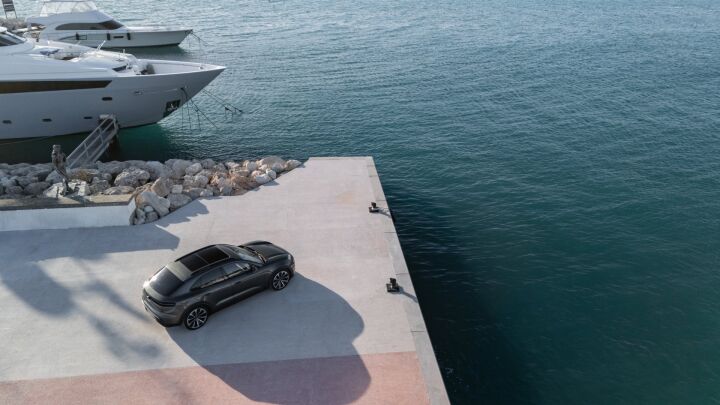
Visually, the Macan Electric is instantly recognisable, yet it carries a much more muscular stance than the car it replaces. Porsche designers have managed to lower the nose significantly because there is no engine to package, resulting in a drag coefficient of just 0.25 - vital for EV range.
A Sharper Aesthetic
The split headlight design is the most controversial element. The top units are purely for the four-point DRLs, while the main LED matrix beams are tucked into the lower bumper. It gives the car a more technical, futuristic face. At the rear, the continuous light bar and the active spoiler (which adjusts based on speed and drive mode) provide a sense of width and purpose. It feels more 'grown-up' than the old car, though perhaps a little less delicate in its detailing.
Inside the Cabin: The Porsche Driver Experience
Stepping inside, you are greeted by what Porsche calls the 'Driver Experience.' The seating position is lower than in many rivals - up to 28mm lower than the old petrol car - which immediately sets the tone. You feel 'in' the car rather than 'on' it.
Material Quality
The build quality is exactly what you would expect for the price. Everything you touch feels substantial, from the knurled toggles for the climate control to the thickness of the steering wheel rim. There is a move towards sustainable materials, but the traditional leather options remain for those who want them. It is a cabin that manages to feel expensive without being overly gaudy.
Infotainment and Connectivity
The dashboard is dominated by screens. There is a 12.6-inch curved instrument cluster for the driver, a 10.9-inch central touchscreen, and an optional 10.9-inch passenger display.
Android Automotive OS
Underneath it all is a new infotainment system based on Android Automotive OS. It is fast - blisteringly so. The navigation calculates routes with charging stops almost instantly, and the integration of third-party apps like Spotify is seamless. However, I am pleased to see that Porsche has retained physical switches for the volume and basic climate functions. It is a sensible middle ground in an era where some rivals are deleting buttons entirely. The optional Augmented Reality (AR) Head-Up Display is a standout feature, projecting navigation arrows so they appear to sit 10 metres ahead on the road.
Practicality: More than a Pretty Face?
Being an SUV, it must perform family duties. The wheelbase is 86mm longer than the old car, which translates directly to more legroom in the back.
Boot Space and the 'Frunk'
The rear boot offers 540 litres of space (reduced slightly in the Turbo due to audio equipment), which is competitive but not very competitive. However, you also get an 84-litre 'frunk' under the bonnet, which is the perfect place to store charging cables, keeping them away from your luggage. It is a practical, well-thought-out space, though the sloping roofline does limit the height of items you can carry in the back compared to a boxier BMW iX3.
Powertrain and Efficiency
The heart of the Macan is its 800-volt system. This is what allows it to charge at up to 270kW. If you find a 350kW Ionity charger, the speed is genuinely impressive.
Real-World Range
While the official figures suggest nearly 400 miles for the RWD version, I would be looking to see how it performs in a British winter. Porsche’s thermal management is usually excellent, and the standard heat pump should help maintain efficiency. On a mixed run in mild weather, I would expect a real-world range of around 280-310 miles for the more powerful variants, which is more than enough for most long-distance journeys.
Performance: The Porsche DNA
Even the 'base' Macan 4 feels urgent. It hits 62mph in 5.2 seconds, which was considered sports car territory not long ago. But the Turbo is a different beast entirely. It reaches 62mph in 3.3 seconds.
Linearity vs. Brutality
What I appreciate most about the Macan’s performance is the calibration. The throttle isn't 'switchy' like some cheaper EVs; it is linear and easy to modulate. You can crawl in traffic smoothly, or you can pin your passengers' heads to the headrests with a flex of your right foot. The noise - a synthetic 'Electric Sport Sound' - is optional. I suspect many will turn it off, but it does help provide a sense of speed in a car that is otherwise eerily quiet.
Ride and Handling: Defying Physics
This is where the Macan Electric needs to win. Weighing in at around 2.4 tonnes, it is a heavy car, but Porsche has used every trick in the book to hide that mass.
The Suspension Logic
Most models will come with air suspension and PASM (Porsche Active Suspension Management). The new two-valve dampers allow for a greater spread between 'Comfort' and 'Sport Plus' modes. In Comfort, it rounds off the sharp edges of UK potholes better than the old car ever did. In Sport Plus, the body control is remarkable.
Steering Finesse
The steering remains the reference point for the segment. It has a weight and a directness that rivals from Audi or Mercedes simply cannot match. You get a genuine sense of what the front tyres are doing. With the optional rear-axle steering, the Macan feels much smaller than it is, darting into corners with an agility that defies its kerb weight. It is, quite simply, the best-handling electric SUV currently on sale.
Driver Assistance and Safety
As expected, the Macan is loaded with sensors. The adaptive cruise control and lane-keep assist work with a level of smoothness that doesn't feel intrusive. I particularly like the way the car uses its recuperation settings; you can choose between a traditional coasting feel or a more aggressive energy recovery, though it doesn't offer a true 'one-pedal' driving mode, as Porsche believes braking should be done via the brake pedal for better feel. This is a philosophical choice that I tend to agree with in a driver-focused car.
What Works and What Doesn’t
What Works
- The Handling: It feels like a Porsche first and an EV second.
- The Charging: 270kW capability makes long trips genuinely viable.
- The Cabin: A perfect blend of high-tech and high-quality.
- The Practicality: The addition of a frunk and more rear legroom is a win.
What Doesn’t
- The Price: Once you start adding essential options, the price skyrockets.
- The Weight: You can't fully escape the laws of physics under heavy braking.
- The Complexity: The sheer amount of screen real estate might be off-putting for traditionalists.
The Rivals
The Macan Electric enters a crowded field. The Audi Q6 e-tron is its closest relative; it offers the same tech for slightly less money but lacks the Porsche’s dynamic edge. The BMW iX3 is an older design now but remains a very efficient and comfortable choice, though it lacks the 'wow' factor. Then there is the Lotus Eletre - larger, faster, and more expensive, but it feels like a very different proposition. The Macan sits in a sweet spot of size, brand prestige, and driver engagement.
Who Should Consider It?
If you are a current Macan owner looking to go electric, this is a easy car to recommend. It improves on the old car in almost every measurable way. It’s also for the buyer who wants an EV but isn't willing to sacrifice the joy of driving for a silent powertrain. It is a premium, multi-talented tool that fits into a professional UK lifestyle with ease.
Who Should Look Elsewhere?
If you need maximum cubic litres of boot space for a growing family and two large dogs, a boxier SUV like a Tesla Model Y or an Audi Q8 e-tron might serve you better. Similarly, if your budget is strictly under £70k, you might find the Macan’s options list frustrating, as it’s very easy to spend £15,000 on 'essentials' like the larger battery/motor combinations and interior upgrades.
The Verdict
The Porsche Macan Electric is a triumph of engineering. Porsche knew they couldn't afford to get this wrong, and they haven't. It is faster, more comfortable, and more technologically advanced than the car it replaces, all while retaining that elusive Porsche 'feel.' It isn't just a good electric SUV; it is one of the best SUVs on the market, full stop. The transition to electric power has not robbed the Macan of its soul; it has simply given it a different, more modern heartbeat.
