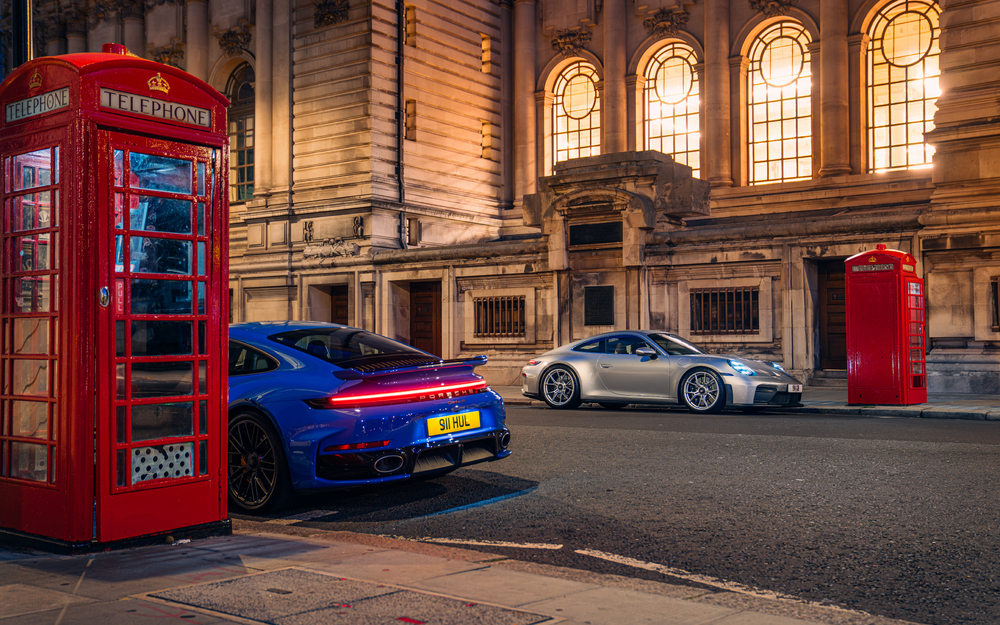
It is difficult to imagine Porsche as an unknown quantity in Britain. Today, the badge is instantly recognisable, the 911 is one of the most enduring sports cars ever created, and Porsche Centres are spread across the country. Yet the relationship between Porsche and the UK began remarkably modestly, with just two cars displayed at the Earls Court Motor Show in London in October 1951.
Those cars were a Porsche 356 coupé and a 356 convertible. Against the backdrop of post-war Britain, they must have looked almost futuristic. Porsche itself describes the 356 as a sleek little German sports car that stood in sharp contrast to the austerity of the time, arriving in the same year as the Festival of Britain and offering a glimpse of the energy beginning to return to the motor industry.
Seventy-five years later, Porsche is marking the anniversary of that first UK appearance, and the story is a fascinating reminder that even the biggest automotive brands often start with one enthusiast, one introduction and a small number of cars.
How Porsche first arrived in Britain
The person at the centre of Porsche’s early UK story was Charles Meisl, a Prague-born car salesman who had become an admirer of Professor Ferdinand Porsche’s work. Meisl contacted Porsche’s export manager in Stuttgart and persuaded the company to provide demonstration cars for the 1951 Earls Court Motor Show.
The response was strong. Contemporary coverage in Autocar praised the performance and styling of the 356, and Meisl went on to become an official Porsche importer in 1952 while working at Colborne Garage in Ripley, Hampshire. In those earliest years, he was effectively building Porsche’s British presence one customer and one car at a time, ordering directly from Stuttgart as demand developed.
That detail is what makes this history so appealing to me. Porsche’s success in Britain did not begin with a vast dealer network or a huge launch campaign. It started because somebody believed in the product strongly enough to make the introduction happen.
Why the Porsche 356 found an audience here
The 356 was not a powerful car by modern standards, but it offered something different. Its rear-mounted boxer engine, lightweight construction and compact shape gave it a distinctive engineering identity, while its styling felt clean and modern compared with much of what was on British roads at the time.
It also arrived at exactly the right moment for Britain’s post-war motorsport culture. As sprint events, hill climbs and circuit racing began to regain momentum, the 356 became popular with enthusiastic drivers who valued traction, handling and mechanical simplicity. By the late 1950s, Porsche says drivers including a young Jim Clark had been drawn to the model and were scoring early wins in it.
That relationship between Porsche and British motorsport would become a defining part of the brand’s reputation here. In 1967, a Porsche 911 driven by Vic Elford won the first ever rallycross event at Lydden Hill in Kent, adding another very British chapter to the brand’s competition history.
AFN helped turn Porsche into a proper UK operation
Charles Meisl’s work eventually brought him into contact with Bill Aldington and AFN, a business with its own strong motorsport heritage through Frazer Nash. Meisl joined AFN in 1954 and the company signed an agreement to import Porsche cars into the UK, giving the brand a more formal sales and service base.
AFN’s headquarters in Isleworth, West London, became the centre of Porsche operations in Britain. Cars arrived from Stuttgart in small batches, were prepared in the workshops and then delivered to customers. For many British buyers, this was their first opportunity to experience Porsche’s particular combination of compact dimensions, detailed engineering and sporting character.
The relationship deepened quickly. The first right-hand-drive 911 arrived in the UK in 1965, and that same year the AFN Porsche operation evolved into Porsche Cars GB, becoming a subsidiary of Porsche AG. The company later moved to Reading in 1977 and has been based in Calcot since 1985.
From one model to a much broader Porsche range
The scale of the change over 75 years is enormous. Porsche began its UK story with the 356, followed by a period where the 911 became the central product. Today, the range spans six model lines and includes combustion engines, hybrids and fully electric cars.
That evolution is important because Porsche has repeatedly had to balance two things that do not always sit comfortably together: protecting its heritage while continuing to move into new categories. The Cayenne, Panamera, Macan and Taycan each challenged a traditional idea of what a Porsche should be, yet all helped broaden the brand’s relevance and customer base.
I have written before about why Porsche’s transaxle models such as the 924, 944, 928 and 968 still feel so special. Those cars are another good example of Porsche being willing to experiment rather than simply repeating the 911 formula. Looking at the full 75-year UK story, that willingness to evolve is one of the clearest themes running through it.
The UK is now one of Porsche’s biggest markets
From that first Earls Court appearance, the UK has grown to become Porsche’s fourth largest market. The brand now has 49 points of representation across its Centre network, stretching from Exeter to Aberdeen, alongside the Porsche Experience Centre at Silverstone.
The Silverstone facility is particularly significant because it was the first Porsche Experience Centre established anywhere in the world when it opened in 2008. Every customer buying a new Porsche is invited to explore the capability of their car there, combining customer handover with driver development and track-based experience.
Porsche is also continuing to invest behind the scenes. Its UK network currently has around 200 apprentices working across technician, bodyshop, parts and service adviser roles, while a new parts warehouse in Didcot is being introduced to support the growing scale of the operation.
Britain’s Porsche story is also a motorsport story
Porsche’s British links extend far beyond retail. Britain has played a major role in Porsche’s international motorsport success, and some of the names involved are central to racing history.
Richard Attwood, from Wolverhampton, helped deliver Porsche’s first outright Le Mans victory in 1970 in the legendary 917. More recently, Bedford-born Nick Tandy became the first driver to win all four major 24-hour endurance races, Le Mans, Daytona, Nürburgring and Spa, all while driving for Porsche factory teams.
Porsche Motorsport GB is also investing in the next generation through the Carrera Cup GB Junior Programme. The scheme gives a young driver a two-year scholarship in identical 510 PS 911 Cup cars, including an £85,000 annual contribution towards their racing budget and wider mentoring support.
That continuity matters. Porsche’s UK story is not simply about how many cars it has sold. It is also about engineering, racing, driver development and the enthusiast community that has grown around the brand.
A 75th anniversary celebrated with proper Porsche detail
Porsche has spent 2026 marking the anniversary in several ways, including the Icons of Porsche Sunstede Silverstone Edition, a two-day celebration that brought thousands of owners and enthusiasts to the Porsche Experience Centre and Silverstone Grand Prix circuit.
A 21-metre Gerry Judah sculpture, previously seen at the 2023 Goodwood Festival of Speed, has also found a permanent home at Silverstone. The structure carries six different 911 models, from a G-Series Targa through to a Type 991 GT3 Cup car, finished in Guards Red, Carrara White and Barley Blue as a nod to the Union Jack.
There is also a lovely circularity to the anniversary story because the same Porsche 356 that appeared at the Earls Court Motor Show in 1951 is still on the road today. That car features prominently in a special edition of The Road Rat magazine created with Porsche Cars GB, bringing the story right back to where it began.
The 911 GT3 Earls Court 51 Edition brings 1951 into the present
Perhaps the most tangible anniversary product is the 911 GT3 Earls Court 51 Edition, created by Porsche Cars GB with Porsche Exclusive Manufaktur. Only 51 examples will be produced, referencing the year of Porsche’s British debut, and pricing starts from £251,951.
The car is based on the 911 GT3 with Touring Package and is finished in a specially developed Paint to Sample Plus colour called Earls Court Green metallic, inspired by the 356 coupé shown at Earls Court in 1951. Inside, Porsche has combined Night Green and Chalk Beige leather with corduroy details to reinterpret period materials without trying to recreate the past too literally.
The driver’s door includes an embossed silhouette of a 356 and the words ‘driving in its purest form’, translated from period marketing used for the original car. It is a small detail, but exactly the sort of thing Porsche tends to do well when it is working with its own history.
A restored 1951 Porsche 356 completes the link
Porsche Cars GB has also worked with the Porsche Sonderwunsch Classic facility near Stuttgart to restore a 1951 Porsche 356 similar to the cars first shown in London. The car retains its original running gear, including a 1.1-litre flat-four boxer engine producing 40 PS, but has received mechanical restoration work and a carefully updated visual treatment.
It now wears the same Earls Court Green metallic paint as the anniversary 911, with Chalk Beige trim, heritage-inspired leather and corduroy fabrics. The result is less a museum piece and more a conversation between two very different eras of Porsche design.
That, for me, is where this anniversary becomes genuinely interesting. It would have been easy to produce a badge, a special logo and a handful of heritage photographs. Instead, Porsche has used the milestone to connect the original 356, the modern 911, its motorsport story, its dealer network and the people who have supported the brand in Britain over seven and a half decades.
Why Porsche’s 75-year UK story matters
Anniversaries can sometimes feel like marketing exercises, but this one has real substance because the story shows how dramatically the automotive industry has changed. Porsche entered Britain with two small sports cars at a motor show. It now operates across performance SUVs, electric cars, hybrids, racing programmes, apprenticeship schemes, retail experiences and one of the most recognisable sports-car lineages in the world.
Yet the basic appeal has remained surprisingly consistent. Porsche’s UK CEO Krishan Bodhani has pointed to the combination of performance and everyday usability as a constant through the decades, and that feels like a fair summary of why the brand has been able to grow without losing its identity.
The 356 that arrived in 1951 and the latest 911 GT3 are separated by huge advances in power, technology, safety and manufacturing, but the underlying idea is still familiar: make something compact, purposeful, engaging to drive and engineered with unusual attention to detail.
Seventy-five years after those first cars appeared at Earls Court, Porsche’s place in British car culture feels secure. What began as one enthusiast persuading Stuttgart to send a couple of cars to London has developed into one of the strongest relationships between a sports-car brand and the UK market. That is a pretty remarkable journey.