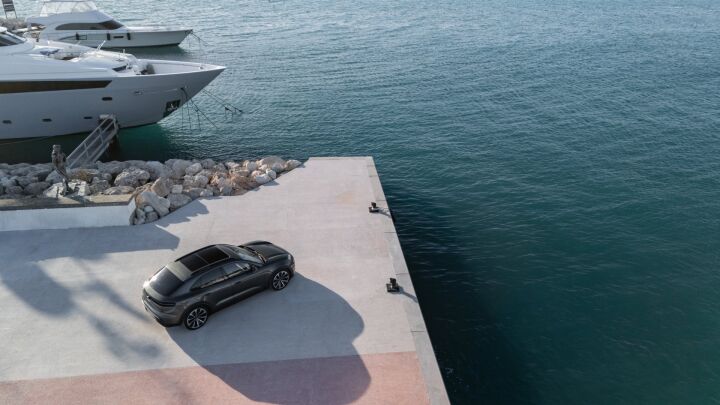
The Porsche Taycan was one of the first electric cars to prove that moving away from petrol did not have to mean giving up everything that makes a car enjoyable.
I was working for a Porsche dealer when the original Taycan arrived, so I was fortunate enough to drive the first-generation Sport Saloon. Even by today’s standards, its performance was mind-blowing. The way it accelerated was almost difficult to process, but what impressed me most was that it still felt unmistakably like a Porsche.
It was low, beautifully balanced and genuinely exciting to drive. It did not feel like Porsche had built an electric car and then tried to make it sporty. It felt like Porsche had built a sports car that just happened to be electric.
However, when the Sport Turismo later joined the range, it immediately became the version I preferred visually. It retained the low, sleek stance of the saloon but added a longer roofline, a proper tailgate and considerably more everyday usability.
I have not yet driven the latest Taycan Sport Turismo, so this is not a fresh road test. It combines my experience of the original Taycan Sport Saloon with a closer look at the current Sport Turismo, its specifications and the substantial improvements Porsche has made.
Sport Turismo or Cross Turismo?
The Taycan is now available as a traditional Sport Saloon, the more adventurous Cross Turismo and the sleeker Sport Turismo.
The Cross Turismo adds raised suspension, standard all-wheel drive and more rugged styling details, including wheelarch trims and protective lower bodywork. It certainly has presence, but I have always preferred the cleaner appearance of the Sport Turismo.
The Sport Turismo effectively combines the additional space of the Cross Turismo with the lower, road-focused stance of the saloon. It does without the off-road-inspired body cladding and is also available with rear-wheel drive.
To my eyes, it is one of the best-looking estates on sale. It is elegant without being anonymous, practical without appearing bulky and recognisably a Porsche from almost every angle.
Performance That Still Feels Extraordinary
Even the entry-level rear-wheel-drive Taycan Sport Turismo is hardly slow.
The current model produces up to 435 PS and accelerates from 0 to 62mph in 4.8 seconds. Prices currently start from £89,400 in the UK. At the opposite end of the range, the Taycan Turbo S Sport Turismo produces up to 952 PS and reaches 62mph in just 2.4 seconds.
Those numbers are impressive, but figures alone do not explain the Taycan.
The original Sport Saloon I drove delivered acceleration that felt completely relentless. There was no waiting for a gearbox to respond or an engine to build power. You pressed the accelerator and the entire car seemed to launch itself towards the horizon.
Plenty of electric cars are now extremely quick in a straight line. What separated the Taycan was the way it behaved everywhere else. The steering, driving position, body control and sense of connection all made it feel like something developed by a sports car manufacturer rather than a technology company.
The latest Taycan should be even more accomplished. Adaptive air suspension with Porsche Active Suspension Management is now standard across the range. Porsche Active Ride is also available as an option on compatible all-wheel-drive models.
Active Ride can counteract the pitching and rolling movements normally experienced during acceleration, braking and cornering. It can even lean the car slightly into a bend, rather than allowing the body to roll outwards.
I would need to drive it before claiming it transforms the experience, but the technology behind it is fascinating, particularly in a large electric car carrying a substantial battery beneath the floor.
More Practical Than the Taycan Saloon
The biggest reason to choose the Sport Turismo is not performance. It is practicality.
The Taycan saloon has a respectable amount of luggage space, but its boot opening can make loading larger objects awkward. The Sport Turismo replaces that opening with a much larger tailgate and provides considerably more height above the load area.
The rear boot can hold up to 446 litres with the standard Sound Package Plus, although models equipped with the Bose system offer 405 litres. Fold the rear seats down and capacity increases to as much as 1,212 litres. There is also an 84-litre storage compartment beneath the bonnet.
The numbers do not make it the largest estate in its class, but the shape of the space makes it far more useful than the saloon. There is more room for suitcases, shopping, camera equipment or a dog, while the additional rear headroom should make life more comfortable for passengers.
It is still a low, sporting car rather than a cavernous family estate. Three adults in the back are unlikely to describe it as spacious, but the Sport Turismo is much easier to live with without sacrificing the Taycan’s appearance.
A Familiar but Screen-Heavy Interior
The Taycan’s interior still looks modern several years after it first appeared.
Its curved 16.8-inch driver display remains one of its defining features, accompanied by a central infotainment screen and an optional passenger display. The overall layout is clean, driver-focused and recognisably Porsche, even if there are far fewer physical controls than in the company’s older models.
It is not perfect. Climate settings are operated through a lower touchscreen, while even the direction of the ventilation can be adjusted digitally. It creates a minimalist appearance, but I still believe commonly used functions are often easier to operate with proper buttons.
For the 2027 model year, Porsche has introduced a faster infotainment system, improved voice control, greater Apple CarPlay and Android Auto integration and fully over-the-air infotainment updates.
There is also a new E-Shift option, which uses eight simulated gears, steering-wheel paddles, artificial shift sensations and a revised electric sound.
I am not entirely convinced an electric Porsche needs to pretend it has a conventional gearbox, but at least the system is optional. I would be interested to experience it before deciding whether it adds some character or simply introduces theatre that the Taycan never needed.
Range and Charging
Range was one of the biggest weaknesses of the earliest Taycan models. It was capable of travelling long distances, but the official figures did not always compare favourably with less sporting alternatives.
The updated car is far more competitive.
Depending on its specification, the current rear-wheel-drive Taycan Sport Turismo offers a WLTP range of between 354 and 416 miles. The 4S, GTS, Turbo and Turbo S models trade some of that ultimate range for additional performance and all-wheel drive.
A WLTP figure should never be treated as a promise. Motorway speeds, cold weather, larger wheels, cabin heating and enthusiastic driving will all reduce the distance available. Even so, a maximum official figure comfortably above 400 miles makes the Taycan a much more convincing long-distance car than it was when first launched.
Its 800-volt electrical architecture also allows compatible models to charge at up to 320kW. Under suitable conditions, the Performance Battery Plus can be charged from 10 to 80% in around 18 minutes using a sufficiently powerful charger.
Of course, finding a charger capable of consistently delivering that speed is another matter. However, when the infrastructure cooperates, the Taycan remains one of the fastest-charging electric cars available.
Tax and Running Costs
The Taycan can still make sense as a company car, although the tax advantages are gradually becoming less generous.
During the 2026/27 tax year, a zero-emission company car attracts a Benefit-in-Kind rate of 4%. That remains considerably lower than the rate applied to an equivalent high-performance petrol car, although the percentage is no longer the 2% figure often quoted in older reviews.
Electric cars are also no longer exempt from Vehicle Excise Duty. A new electric car registered during the 2026/27 tax year pays £10 in its first year and the standard £200 annual rate afterwards.
Because every new Taycan Sport Turismo costs considerably more than £50,000, it will also be subject to the expensive-car supplement for five years from its second year of registration.
Running costs are unlikely to be insignificant either. Insurance, replacement tyres and Porsche servicing all need to be considered. The options list can also turn an already expensive car into an exceptionally expensive one with surprising speed.