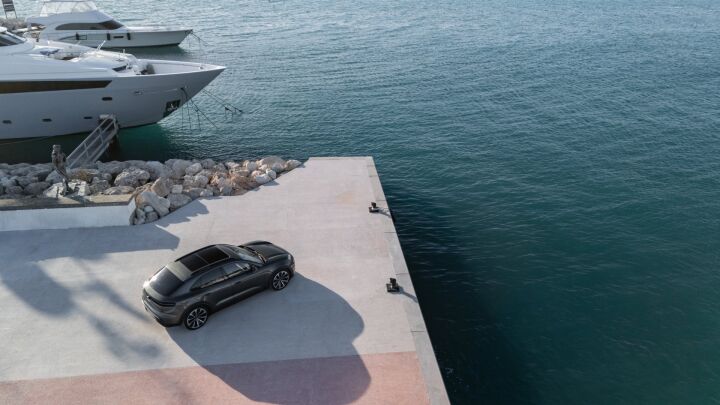
Before spending a few days living with the Polestar 4, I’d already driven the entire Polestar range at a Polestar Experience event at Bicester Motion.
That gave me the opportunity to try the cars on the road, but also to push them a little harder through slaloms and some of the tighter, twistier sections of the circuit. It was enough to establish that Polestar takes the word ‘performance’ in its branding fairly seriously.
The more revealing experience, though, came when I was handed the keys to a Polestar 4 Long Range Single Motor and given the opportunity to use it as an actual car.
Motorways, dual carriageways, town driving, parking, country lanes and some rather enjoyable B-roads around the South Downs followed. I also completed a roughly 200-mile journey in it.
And the more time I spent in it, the more I liked it.
It feels expensive before you even start driving
One of the Polestar 4’s strongest qualities is difficult to convey through a specification sheet. It simply feels extremely well made. Close a door and there’s reassuring solidity to it. Move around the cabin and the different panels, materials and controls feel as though they belong together rather than being sourced separately and assembled around a giant touchscreen.
Nothing in my test car rattled or felt loose. The materials feel substantial and the whole interior has that dense, well-engineered feeling traditionally associated with some of the better German premium cars. That matters when the Rear motor Polestar 4 currently starts at £56,750. The Dual motor starts at £63,750, before you start exploring some of the more expensive packs and options.
At this money, ‘quite nice inside’ isn’t good enough. Thankfully, the Polestar feels genuinely premium.
A minimalist cabin that still gives the driver information
I’ve driven plenty of modern EVs that interpret minimalism as removing virtually everything from the dashboard. Polestar has resisted going quite that far. There’s a 10.2-inch display directly in front of the driver and a large 15.4-inch central touchscreen. Cars equipped with the Plus pack also gain a 14.7-inch head-up display. That combination works for me.
I want my speed, navigation information and essential driving information directly ahead. I don’t particularly want to glance sideways at a central screen every time I want to know how quickly I’m travelling. The main screen itself is sharp, fast and well presented, and you can customise the interface with shortcuts to the functions you use most often. That became particularly useful for something rather less glamorous: turning off the speed-limit warning.
During my time with the car, it repeatedly thought sections of the A23 dual carriageway were limited to 60mph, then later suggested that some B-roads had a 70mph limit. Being able to get quickly to the relevant assistance setting became quite important.
Google built in has finally made me question Apple CarPlay
For years, I’ve been a committed Apple CarPlay user. The Polestar 4 might have changed my mind. Wireless Apple CarPlay is available, but Polestar’s own connected system gives you access to Google Maps, Google Assistant and downloadable third-party apps including services such as Waze, YouTube and other applications through Google Play. I found myself preferring the native system.
The problem with CarPlay in cars where so many vehicle controls live inside the central touchscreen is that CarPlay effectively takes over that screen. Want to change a climate setting or adjust something in the car? You end up jumping out of CarPlay, finding the vehicle menu, changing your setting and then navigating back again. It is hardly a major hardship, but it creates unnecessary tapping.
With the native apps, maps, music and the car itself feel like one integrated system rather than two operating systems fighting for the same screen.
Some technology is slightly too keen to help
There is another side to all that technology. The Polestar 4 watches an awful lot. Polestar lists 11 exterior cameras, a driver-monitoring camera, radar and 12 ultrasonic sensors as part of the car’s assistance and safety hardware. And sometimes you know they’re there. I found the driver-fatigue monitoring rather keen to get involved, while the collision warning could be extremely sensitive.
The most dramatic example happened while I was parallel parking. The car suddenly performed an emergency stop so sharply that my immediate reaction was that I must actually have hit something. I hadn’t.
I would always rather a safety system intervene unnecessarily than fail to intervene when it genuinely matters, but there is a balance to be struck. Too many warnings eventually risk becoming something drivers automatically dismiss.
This is still a driver’s car
Where the Polestar 4 really separates itself from many electric SUVs is once the road becomes interesting. The version I spent most time with was the rear-wheel-drive model, producing 268bhp and 253lb ft of torque. Polestar quotes 0-60mph in 6.9 seconds, while the more familiar 0-62mph figure is around 7.1 seconds. By modern EV standards, that isn’t particularly dramatic. And I genuinely don’t care.
You can plant your foot down and it moves with more than enough urgency for everyday driving. What interested me far more was what happened when the road started twisting. There is a tightness to the chassis that makes the Polestar feel reassuringly controlled. Direction changes are clean, body movement is kept in check and it feels like a large car that has actually been tuned by people who enjoy driving.
I first noticed that at Bicester Motion, threading it through slaloms and tighter bends. It became even more apparent on the roads around the South Downs. This is not an EV that happens to be fast. It feels like a car whose chassis has been given some actual attention.
The Rear motor and standard Dual motor use high-capacity passive dampers, while the Dual motor Performance pack introduces specially tuned active ZF dampers, stiffer springs and anti-roll bars.
Firm? Yes. Uncomfortable? No.
The trade-off is that you feel the road. Hit a rough patch or a significant bump and the Polestar lets you know about it. Personally, I don’t mind that. I would rather a car like this feel tied down and controlled than float along while isolating you from everything beneath the tyres. More importantly, firmness hasn’t come at the expense of long-distance comfort. I completed a journey of roughly 200 miles and enjoyed every mile of it. A huge part of that is down to the seats.
Some of the best seats I’ve used recently
The front seats are exceptionally supportive. With the relevant equipment you get 12-way electric adjustment, lumbar support, easy entry and exit and a manually extendable thigh support. That last one is particularly useful for taller drivers, or anyone with longer thighs who finds that conventional seat bases finish too early. I could get the seat base, angle and lumbar support exactly where I wanted them. After several hours behind the wheel I wasn’t shifting around trying to find a different position. That is probably the biggest compliment I can give a car seat.
There is, however, a slightly ridiculous ergonomic oversight elsewhere. The front door pocket wouldn’t comfortably accept the fairly ordinary medium-sized Buxton sports-cap bottle I had with me. Not a giant two-litre bottle. Just a normal bottle of water. For a big premium SUV-coupé, that seems oddly mean.
Rear passengers arguably get treated even better
If anything, the back of the Polestar 4 feels even more luxurious. There is enormous legroom, helped by a wheelbase just shy of three metres, while versions fitted with the Plus pack offer electrically reclining rear seatbacks and a 5.7-inch rear touchscreen for media and climate functions. It creates an almost lounge-like feel.
Polestar’s controversial decision to remove the rear window also allowed the roof structure to be pushed further backwards, helping create additional space above rear passengers despite the coupé-like roofline. From the passenger’s perspective, there’s a logic to it. From the driver’s seat, I’m still not convinced.
About that missing rear window...
The Polestar 4 has no conventional rear windscreen. Instead, a roof-mounted HD camera sends a live image to an 8.9-inch digital rear-view display. You can switch the screen into a conventional reflective mode, but then you’re simply looking at the passengers behind you because there is no glass beyond them. Technically, it works. The picture is exceptionally sharp. The field of view is wide and you can see things that might otherwise be blocked by passengers, luggage or the bodywork of the car. I still don’t particularly like it.
There is something instinctive about glancing into a mirror and focusing into the distance behind the car. Looking at a screen a few centimetres from your face requires your eyes to refocus differently. Some people will adapt within a day and wonder why anyone cared. I spent several days with it and would still rather have a piece of glass.
Styling: handsome, but the coupé shape isn’t really for me
From the front, I think the Polestar 4 is excellent. It is clean, distinctive and recognisably Polestar without resorting to an enormous fake grille or excessive decoration. The split lighting gives it presence and the proportions make it look wide and planted.
From the side and rear, my enthusiasm drops slightly, but this is purely personal. I have never been the biggest fan of SUV-coupés. Give me the more upright practicality of a conventional SUV and I’ll normally take it.
That makes the forthcoming Polestar 4 SUV particularly interesting. Polestar has confirmed the new SUV variant will go on sale from 2 September 2026, promising extra practicality and versatility while retaining the 4’s performance focus. It will continue with the 400V architecture, with Polestar quoting up to 630km, roughly 391 miles, of WLTP range for Rear motor versions.
That could potentially be much more my sort of thing.
Range and charging
Both versions of the current Polestar 4 Coupé use a 100kWh battery. The Rear motor manages up to 385 miles on the WLTP cycle, while the Dual motor offers up to 367 miles. The more powerful car produces 536bhp and 506lb ft, cutting the 0-62mph sprint to around 3.8 seconds.
Charging peaks at 200kW DC, with Polestar quoting 10 to 80 per cent in 30 minutes. Standard AC charging is 11kW, although 22kW AC charging is available as an option.
Two hundred kilowatts is perfectly usable, but in a premium EV market increasingly populated by 800V cars capable of higher charging speeds, this is one area where the Polestar no longer looks particularly cutting edge.
Practicality
The Polestar 4 is 4,840mm long, 2,139mm wide including its mirrors and sits on a huge 2,999mm wheelbase. There is a 526-litre boot beneath the tailgate, expanding to 1,536 litres with the rear seats folded, plus another 15 litres beneath the bonnet.
So while the roofline looks dramatic, this is still a genuinely useful family car.
Which version should you choose?
Having driven the range, the Dual motor is obviously entertaining.
With 536bhp and all-wheel drive, it offers the sort of acceleration people have come to expect from high-performance EVs. But the Rear motor is the one I find more interesting. It has enough performance, the longest official range and rear-wheel drive, while retaining the responsive chassis that makes the Polestar enjoyable. For daily use, I’m not convinced I would gain enough from the additional 268bhp of the Dual motor to compensate for the additional cost and slightly reduced range.
The Prime pack is worth knowing about too, combining the Pilot, Comfort and Plus packs with rear privacy glass. Those packs introduce features including Pilot Assist, park assist, the head-up display, Harman Kardon audio, rear touchscreen, improved seat adjustment, heated rear seats and electrically reclining rear seatbacks.
The Performance pack goes much further, adding 22-inch forged wheels, Brembo brakes and the active Polestar Engineered chassis to the Dual motor.
Exterior colours currently include Electron, Gold, Magnesium, Snow, Space and Storm.
Is the Polestar 4 safe?
This was one area where the car genuinely impressed me. It feels solid when you’re driving it, but there is evidence behind that feeling. Euro NCAP awarded the Polestar 4 five stars in 2025, including 92% for adult-occupant protection, 85% for child occupants, 81% for vulnerable road users and 79% for safety assistance.
Having watched the crash-test footage, it reinforces something I felt throughout my time with the car. If the worst happened, this is one of the cars I would rather be sitting in.
Polestar 4 verdict
The Polestar 4 is a slightly strange car to summarise because some of the things I like least about it are also the things Polestar is most proud of. I don’t need the missing rear window. I would like a few more physical controls. I would appreciate some of the driver-assistance systems relaxing occasionally. But underneath those frustrations is an exceptionally good car.
It feels beautifully built. The seats are superb. The cabin is spacious. The technology is genuinely useful when it works with you rather than interrupting you, and, most importantly, someone has remembered that the person sitting behind the steering wheel might actually enjoy driving.
The Rear motor will not melt your face with acceleration. Instead, it gives you enough performance to enjoy yourself, enough range to make long journeys easy and a chassis that makes a decent B-road something to look forward to.
In an EV market increasingly obsessed with huge power figures, enormous screens and ever more gimmicks, I find that rather refreshing.