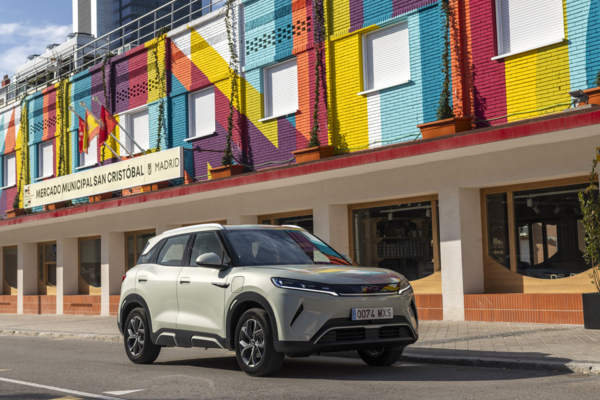
The BYD ATTO 2 is a neat, well-equipped compact electric SUV with useful space and a strong warranty, but the launch Boost version's 214-mile range and 82kW rapid charging make its £30,850 price harder to call a bargain. The strengths are the equipment, packaging and BYD's battery technology rather than outright long-distance ability.
BYD has expanded quickly in the UK, and the ATTO 2 is positioned as a smaller, more affordable SUV below the ATTO 3. At 4.31 metres long it should be easy enough to live with in town, yet the 2.62-metre wheelbase and dedicated EV construction give the cabin more room than the exterior dimensions initially suggest.
Design and first impressions
The ATTO 2 is more conventional looking than some of BYD's other cars, which may actually help it. The proportions are upright and tidy, with enough detailing to look modern without becoming overly busy. It feels designed to appeal to buyers moving out of a conventional small SUV rather than asking them to buy into something radically different.
The compact footprint is one of the car's more appealing qualities. Plenty of electric SUVs have grown far beyond the size their buyers really need, while the ATTO 2 still looks manageable enough for narrow roads and urban parking.
Inside the cabin
BYD makes a strong equipment case, including a heat pump, Vehicle-to-Load capability, a rotating central screen, a 360-degree camera and a broad suite of assistance systems. Those are meaningful features rather than decorative extras, particularly the heat pump because it can help winter efficiency and the V2L system because it allows the car to power external electrical equipment.
The rotating screen remains a BYD signature, although I would spend more time checking menu logic and climate controls than watching it move between portrait and landscape. Technology is at its best when it makes ordinary tasks easier after the showroom demonstration is over.
Space and practicality
The boot holds 400 litres with the rear seats up and 1,340 litres when they are folded, which is useful for a compact SUV and should cover most small-family needs. The Cell-to-Body construction integrates the battery into the structure, helping BYD create a relatively spacious cabin without making the body excessively tall or long.
I would still take the family's normal luggage and sit behind the driver's usual seating position before deciding. A generous wheelbase helps, but the most useful family-car test remains whether the people and belongings that travel with you fit without an elaborate compromise.
Battery, range and charging
The UK launch Boost uses a 51.1kWh Blade Battery and is rated at 214 miles on the combined WLTP cycle. That is perfectly workable for commuting and ordinary family travel, but it does not provide the same long-distance margin as several rivals at similar money.
Rapid charging peaks at 82kW DC, with BYD quoting around 30 minutes for a 30-to-80 per cent refill and roughly 38 minutes from 10 to 80 per cent. That is adequate for occasional longer journeys, but noticeably behind the fastest small and medium EVs.
At home, the standard 11kW AC onboard charger is more important because the battery is relatively modest and can be replenished easily overnight. The issue is not that the ATTO 2 is unusable on long trips, but that once the price moves above £30,000 buyers have every reason to compare both range and charging performance closely.
Performance and road character
The 130kW front motor produces 290Nm and reaches 62mph in 7.9 seconds, with a 99mph top speed. That is comfortably adequate for a compact family SUV, and I would rather BYD prioritise efficiency and ride comfort than chase a performance figure that adds little to everyday ownership.
I have not driven this particular ATTO 2, so I would want a test drive to focus on low-speed ride, steering consistency and the behaviour of the assistance systems. Independent European testing generally described the car as easy-going and comfort-focused rather than sporty, which sounds appropriate for its role.
Which version makes sense?
The Boost was the original UK launch version, but BYD later introduced a larger-battery Comfort model with substantially more range and faster charging. That makes the exact derivative especially important when comparing used and new examples because the later car changes the long-distance proposition considerably.
If the price gap is sensible, I would compare the longer-range version before committing to Boost. If most of your driving is local and home charging is easy, the launch car can still make perfectly good sense, particularly if the lease support is stronger.
Leasing and alternatives
The Kia EV3 offers substantially more official range in some versions, while the Vauxhall Frontera Electric gives more physical space for less money but also less range. The Hyundai INSTER is smaller and cheaper, while the Dolphin Surf is worth considering if the priority is simply getting into an EV at the lowest sensible cost.
Verdict
The ATTO 2 is a well-packaged, well-equipped electric SUV, and I can see why somebody who likes BYD's technology would prefer the raised driving position and conventional family-car shape. The difficulty is that the launch Boost does not dominate on either range or charging, which makes the price more important than it would be if the technical numbers were class-leading.
I would put it on the shortlist, but I would not order without comparing the exact live lease against a Kia EV3 and the later long-range ATTO 2. If BYD's warranty, equipment and cabin appeal outweigh the range difference, it makes sense; if long-distance use is central to the brief, there are stronger choices.


