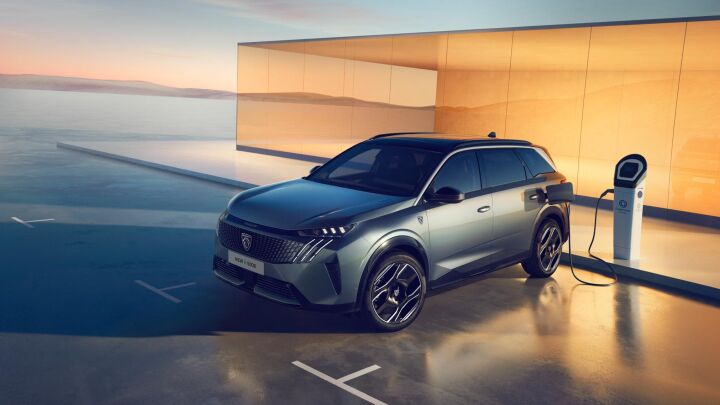
The Peugeot E-3008 is one of the most distinctive electric family SUVs of its generation, with a cabin that feels genuinely different and a useful official range of up to 326 miles from the launch 73kWh battery. It is not the obvious class leader on charging speed or value, but it has enough personality and substance to deserve a place on any serious family-EV shortlist.
The first thing that stands out with the E-3008 is that Peugeot has not treated electrification as an excuse to become visually anonymous. The old 3008 already had one of the more recognisable interiors in the class, but this generation pushes the idea much further, combining a fastback-inspired body with a cabin that feels deliberately more dramatic than the usual large screen sitting on an otherwise conventional dashboard. That matters because electric SUVs are increasingly difficult to tell apart, and the Peugeot has a sense of identity that many rivals simply do not.
Design and first impressions
The exterior is sharper and more sculpted than the previous 3008, with a high waistline, slim lighting and a rear end that sits somewhere between a conventional SUV and a coupe. It is still a practical five-door family car, but the proportions make it look more expensive and more distinctive than many mainstream alternatives. I think that works well because the E-3008 needs to justify a price that places it alongside some very capable electric competition.
There is also a useful amount of restraint in the details. Peugeot has resisted the temptation to make the car look futuristic simply because it is electric, and the result feels modern without becoming gimmicky. The shape is more style-led than something like a Skoda Enyaq, but not so extreme that it compromises the basic family-car brief.
Inside the cabin
The interior is easily the E-3008's strongest talking point. GT models use Peugeot's curved 21-inch panoramic display above the small steering wheel, while the dashboard wraps around the driver with a raised centre console and configurable i-Toggles below the main screen. It looks much more considered than a generic tablet-led layout, and the combination of materials, lighting and screen design gives the cabin a stronger sense of occasion than you might expect from a mainstream SUV.
The usual Peugeot caveat remains, because the i-Cockpit layout will not suit everyone. The small steering wheel is designed to sit low while the instruments are viewed above it, and some drivers find the arrangement natural while others struggle to position the wheel without obscuring part of the display. I would make that the first thing to check in the showroom because it will affect every journey, whereas most of the impressive visual details become background after the first few weeks.
Space and practicality
Despite the more coupe-like roofline, the E-3008 remains a proper five-seat family car. Peugeot quoted 520 litres of luggage space at launch, while later UK specifications use a different measurement method and quote a larger figure, so direct comparisons with rivals need a little care. In practical terms, the opening is broad, the floor is useful and there should be enough room for the usual mix of shopping, holiday luggage and family equipment.
The car is 4,542mm long and 1,895mm wide excluding mirrors, which makes it substantial without feeling oversized. Rear-seat room is competitive rather than class-leading, and that is where I would compare it directly with more upright rivals. If maximum headroom and luggage flexibility matter more than style, something boxier will still have an advantage, but the E-3008 does not feel as compromised as the shape might suggest.
Performance, range and charging
The launch 73kWh Standard Range car produces 210hp and 343Nm through the front wheels, with 0-62mph taking 8.8 seconds. That is enough performance for a family SUV, and I actually think Peugeot was right not to chase a headline acceleration figure at the expense of efficiency and comfort. Smooth response, easy overtaking and refinement matter far more in this sort of car than being able to embarrass a hot hatch away from the lights.
The official range of up to 326 miles is useful because it gives the E-3008 enough margin to work as a household's main car rather than simply an urban EV. As always, motorway speeds, winter temperatures and heating will reduce the number you see in practice, but starting above 300 miles makes occasional long-distance travel far easier to manage.
Rapid charging peaks at up to 160kW DC, with an 11kW AC onboard charger for home and destination charging. That is perfectly usable, but not class-leading, and this is one area where some newer rivals have moved ahead. The important question is how often you will actually rely on rapid charging; if most energy goes in overnight at home, the peak figure matters far less than it does for somebody covering several hundred motorway miles every week.
What is it likely to be like on the road?
I have not driven this particular E-3008 derivative, so I would not pretend to give you a first-hand road-test verdict. What the specification and the independent launch tests do tell us is where the important questions are likely to be. Refinement and cabin isolation were generally well received, while ride quality on larger wheels attracted more mixed comments, so I would deliberately include broken urban surfaces and a rougher B-road on any test drive rather than spending the whole time on a smooth dual carriageway.
That suits the character of the car anyway. The E-3008 is not being pitched as a sporty electric SUV; its job is to make everyday travel feel quiet, easy and slightly more special than the average family crossover.
Which version makes the most sense?
At launch, the 73kWh Allure started at £45,850, with GT costing more. My instinct would be to begin with the lower trim and only move up for equipment that genuinely improves everyday use, because the same basic battery and motor already deliver the useful part of the car. Peugeot later added Long Range and dual-motor versions, but the standard 210hp car remains the sensible reference point for most buyers.
If long motorway journeys are a regular part of your week, the larger-battery Long Range version becomes easier to justify. If most travel is under 100 miles a day, the standard battery is likely to be plenty and avoids paying for capacity you may rarely use.
Leasing and alternatives
The Peugeot E-5008 is the obvious step up if seven-seat flexibility matters, while the Skoda Elroq offers a more practicality-led approach. I would also compare the Ford Explorer EV and Renault Scenic E-Tech because both make a strong case around family usability and range.
Verdict
The E-3008 is memorable in a segment where too many cars are merely competent. I particularly like the way Peugeot has treated the cabin as a design project rather than simply finding somewhere to mount a screen, and the 326-mile official range gives the standard car enough substance to go with the styling.
My reservation is value. At its original launch price I would not overlook ride comfort, rear-seat space or charging speed simply because the dashboard looks expensive, so a proper test drive and a live lease comparison are important. If the driving position suits you and the current monthly pricing stacks up, the E-3008 is one of the more interesting mainstream electric SUVs you can choose.