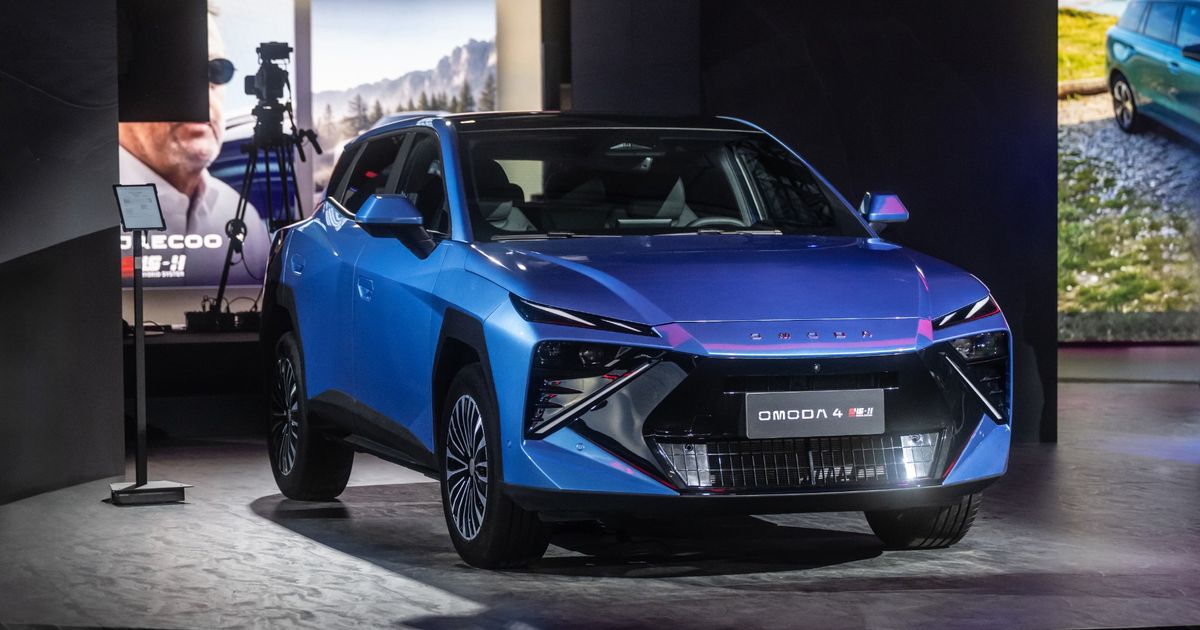
Yes, Chinese cars can be reliable, but it is too simplistic to judge every Chinese-made car together. Established manufacturers such as MG now have meaningful UK reliability data, while many newer brands simply have not been on British roads for long enough to build a dependable long-term record.
If you had asked me about Chinese cars five or six years ago, this would have been a very different article. Today, brands such as BYD, MG, OMODA, JAECOO, Chery, Geely, Leapmotor and Changan are becoming increasingly familiar on British roads, and the quality of the cars arriving here has moved on quickly.
Are Chinese cars reliable in the UK?
The honest answer is that some now have strong evidence behind them, while others are still too new for us to know how they will perform over five, eight or ten years. That uncertainty matters, but uncertainty is not the same thing as unreliability.
The more useful question is whether a particular car, manufacturer and UK support network are dependable. I would judge an MG, BYD, Geely or Chery in exactly the same way I would judge a Toyota, Volkswagen or Kia, looking at the individual model, warranty, dealer coverage, parts operation and independent reliability evidence.
Is it fair to talk about Chinese car reliability as one thing?
Not really, because China now produces cars across an enormous range of manufacturers, price points and engineering standards. We would never expect one answer about “European car reliability” to cover a Dacia, Porsche, Volkswagen and Ferrari, and the same logic should apply here.
Many brands that are new to British buyers are backed by very experienced automotive groups. Geely belongs to a wider group with links to Volvo, Polestar, Lotus and Zeekr, SAIC owns MG, and Chery has been producing vehicles for decades even though its own badge is relatively new to UK motorists.
What does current UK reliability data tell us?
MG provides one of the clearest examples because it has been established in modern Chinese-owned form in Britain for long enough to generate useful owner data. In the 2026 What Car? Reliability Survey, MG achieved a score of 92.0% and finished ninth out of 30 manufacturers, while the MGS5 EV topped its category.
That is particularly interesting because MG did not always enjoy a strong reliability reputation, so the result suggests its newer products and aftersales operation are moving in the right direction. I have looked at this in more detail in my MG reliability article, which explains why the brand's recent improvement matters.
Have I noticed Chinese cars improving?
Very much so, and this is where first-hand experience adds something that reliability tables cannot. I have driven a growing number of cars from Chinese manufacturers, including the Geely EX2, Changan Deepal S05, Leapmotor B10 and several MG models, and the improvement in basic quality is difficult to ignore.
The biggest change is not simply that these cars have huge screens or lots of equipment. Doors feel substantial, cabin materials are improving, software is becoming more polished and the cars increasingly feel engineered for European buyers rather than merely adapted for them after the event.
Does good build quality mean a car will be reliable?
No, because a car can feel beautifully assembled and still develop electrical, software or mechanical problems. Modern reliability is also more complicated than it used to be because infotainment systems, cameras, sensors, driver assistance technology and connected services can create problems even when the basic powertrain is perfectly dependable.
This is not a uniquely Chinese issue, and plenty of European, Japanese, Korean and American cars have suffered from software faults. The difference with a newer brand is that the dealer and technical support network may still be developing, so how quickly a fault is fixed can matter almost as much as whether the fault happened in the first place.
What should I check about parts and aftersales support?
I would always look beyond the warranty headline and ask how the manufacturer actually supports customers once something goes wrong. A seven-year warranty sounds excellent, but it is much less reassuring if a car has to spend weeks waiting for a specialist component or there is no convenient authorised repairer nearby.
MG has been investing in its UK parts and technical operation, including expanded distribution and training capacity, which gives me more confidence in the ownership experience. With any newer manufacturer, I would check dealer coverage, where parts are held, how warranty repairs are handled and whether another authorised repairer can step in if your nearest retailer closes.
Are long warranties enough to make a Chinese car a safe choice?
A long warranty is useful, but the detail matters more than the headline number. Check mileage limits, what happens when the car changes owner, whether the battery has separate terms and exactly which legal company stands behind the guarantee.
I also think buyers should remember that warranty length is only part of ownership confidence. Parts availability, insurer appetite, servicing support, software updates and the likely future value of the car all deserve attention as well.
Are Chinese electric car batteries reliable?
There is no convincing evidence that an EV battery should be considered unreliable simply because the car was built by a Chinese manufacturer. Large-scale battery studies are increasingly showing that modern EV batteries generally lose capacity gradually rather than suddenly becoming unusable after a few years.
Geotab's 2026 analysis of more than 22,700 electric vehicles found average battery degradation of around 2.3% per year, although results varied depending on vehicle design, climate and charging behaviour. That does not prove every Chinese EV will be faultless, but it does challenge the idea that the battery itself should automatically be treated as a reason to avoid one.
Should I worry about buying from a new Chinese brand?
I would be cautious rather than worried, because unfamiliarity on its own does not make a manufacturer unsafe. What matters is who owns the company, how large and experienced the parent group is, how much it is investing in Britain and whether there is credible infrastructure behind the product.
I would also think about depreciation and long-term brand confidence, especially if I were buying with my own money. That is one reason I have written a separate guide on whether you should buy or lease a Chinese car, because leasing can shift some of the future residual-value risk away from the driver.
Which Chinese brands would I feel most comfortable considering?
I would not create a simplistic good-brand and bad-brand league table, because the individual vehicle still matters enormously. However, MG now has scale and useful UK reliability evidence, BYD has enormous global manufacturing experience, Geely sits within a highly experienced international automotive group, and Leapmotor's European operation benefits from its relationship with Stellantis.
Chery is also investing heavily in Europe and Britain through several brands, while newer entrants such as Changan are arriving with substantial engineering resources behind them. None of that guarantees an individual car will never go wrong, but it means I would not dismiss these manufacturers simply because British buyers are still learning their names.
Would I buy a Chinese car myself?
Yes, if the right car came along, because I have now driven Chinese-built and Chinese-owned cars that I would happily have on my own driveway. I would not choose one purely because it offered the most equipment for the least money, but nationality would be quite a long way down my decision list.
I would ask whether I enjoy driving it, whether it is comfortable, safe and sensibly insured, whether I have a dealer nearby, how good the warranty and parts support are, and what I think will happen to its value. Those are the same questions I would ask about any unfamiliar car, regardless of where it was designed or built.
Are Chinese cars reliable? My verdict
The evidence does not support dismissing Chinese cars as inherently unreliable, although long-term UK data is still limited for many newer brands. Some established Chinese-owned manufacturers now have competitive reliability results, while others need more time before we can make confident claims about long-term durability.
Having driven a growing number of these cars myself, I have seen a significant improvement in quality, refinement and engineering. My advice is to judge the car, the company behind it and the support network around it rather than judging the passport of the factory that built it.