There are some things about modern motoring that still surprise me. We have cars that can spot pedestrians, warn us about hazards and practically park themselves, yet thousands of people are still getting behind the wheel, or climbing into the passenger seat, without bothering to put on a seatbelt. It takes a couple of seconds. Surely, by now, it should be second nature?
Apparently not. New research from Volvo Car UK has revealed that 107,969 seatbelt enforcement notices were issued to drivers and passengers between 2023 and 2025. That works out at almost 100 notices every single day across the 37 police forces that supplied the figures. And when you consider just how serious the consequences can be, it is a pretty sobering number.
More than 100,000 notices, and the problem isn't going away
Volvo obtained the figures through Freedom of Information requests to UK police forces. The data shows 35,363 notices in 2023, increasing to 37,067 in 2024, before easing slightly to 35,539 in 2025. In other words, the most recent year was hardly a dramatic improvement on where things started.
There is an even more revealing comparison. Among the 21 police forces with consistent records going back to 2019, the number of seatbelt enforcement notices was 39% higher in 2025 than in 2019. That is a comparison of notices issued, rather than proof that 39% more people are driving without a belt. Police resources, enforcement campaigns and recording practices can all affect the figures, but the underlying safety message is difficult to ignore.
West Yorkshire recorded the highest number of notices in 2025, at 5,062. Devon and Cornwall followed with 2,874, then West Mercia with 2,516 and Greater Manchester with 2,509. Those figures don't necessarily mean people in one area are less safety-conscious than elsewhere. They may also tell us something about how actively offences are being identified.
The statistic that really matters is much more serious
As interesting as the police figures are, the numbers that genuinely stopped me in my tracks came from the Department for Transport. In Great Britain in 2025, around one in four car occupants killed in reported road collisions were not wearing a seatbelt, among those whose seatbelt-wearing status was known.
It's a dreadful thought. We all understand that road accidents can happen in an instant, regardless of how carefully we drive. A seatbelt cannot guarantee that you will walk away from a serious collision, but choosing not to wear one removes a vital layer of protection before the journey has even begun.
The Department for Transport's 2025 road casualty analysis also identifies seatbelt non-wearing as one of the behaviours associated with the most serious collisions. Its more detailed research points to particular concerns around rear-seat passengers and journeys close to home. Those short, familiar trips can feel harmless, but familiarity doesn't make a collision any less dangerous.
Yes, wearing a seatbelt is still the law
In the UK, drivers and passengers must wear a seatbelt when one is fitted, unless a legal exemption applies. That includes people sitting in the back. There can be a £100 fixed penalty for not wearing one, with a fine of up to £500 if the case goes to court. Drivers are also responsible for making sure children under 14 are properly restrained.
But I think this is one of those situations where the fine should be the least of anybody's worries. Whether you're driving to the supermarket, travelling home in a taxi or heading off on a long motorway journey, it's a remarkably simple precaution to take. For the exact rules and exemptions, the government's seatbelt guidance is worth reading.
Volvo helped give us the modern seatbelt. Now it's changing it again
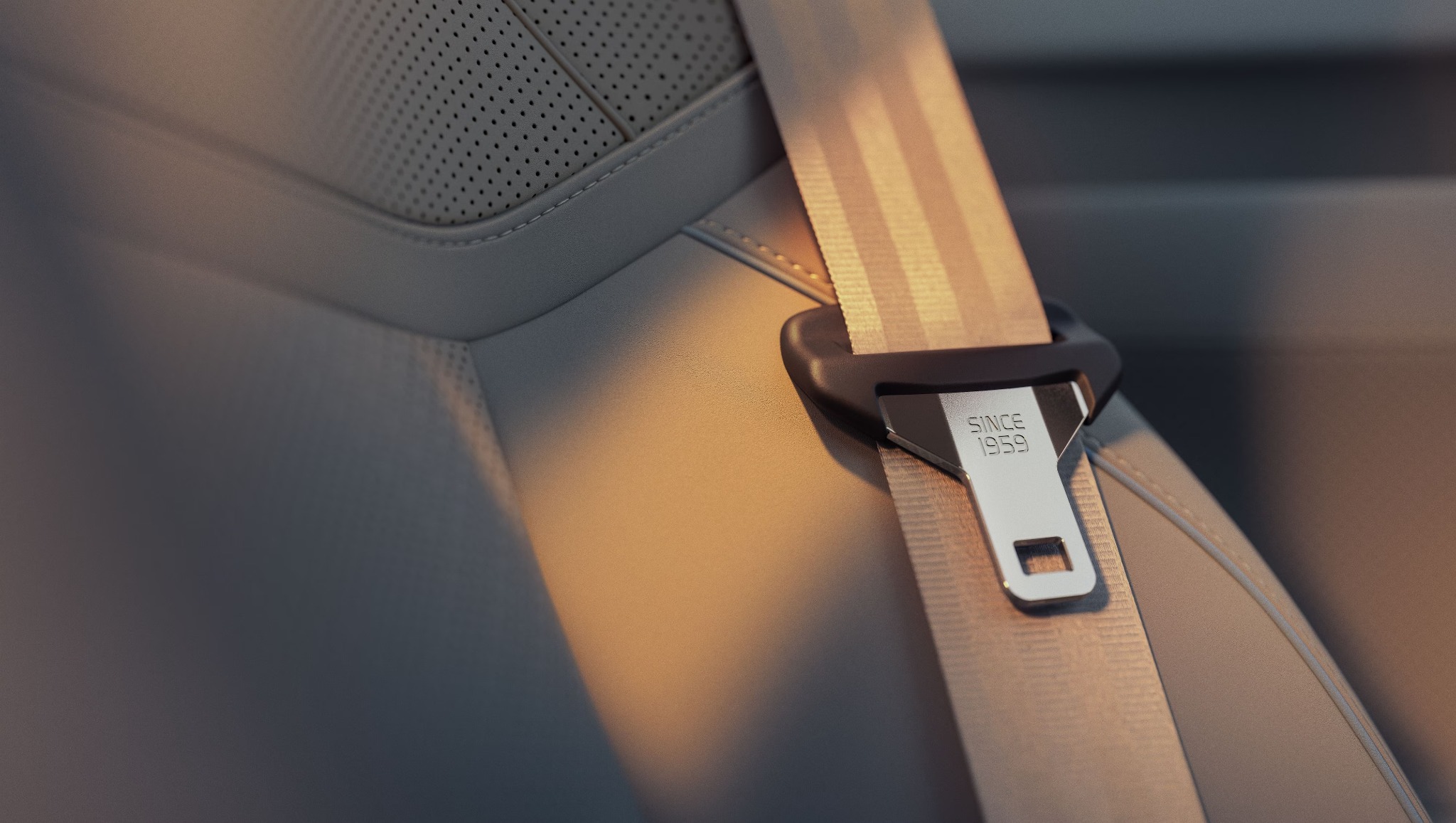
There is something particularly fitting about Volvo being the company to highlight these figures. Back in 1959, the Swedish manufacturer introduced the modern three-point safety belt as standard equipment. Rather than keeping the invention to itself, Volvo made the patent available to other carmakers free of charge. It is one of the automotive industry's most important safety decisions, and one that deserves far more recognition than it gets.
Almost seven decades later, Volvo is still working on the same fundamental idea. The new all-electric Volvo EX60 introduces what the company calls the world's first multi-adaptive safety belt. Instead of responding in exactly the same way in every situation, the system uses information from the car's sensors to adjust occupant protection according to the circumstances of a collision.
That is clever engineering, and exactly the sort of safety development I like seeing from manufacturers. I've always appreciated Volvo's approach to building cars that feel designed around the people inside them, rather than simply chasing the latest headline-grabbing gadget. You can explore more of my Volvo news and reviews, including the EX30, elsewhere on the site.
My view: it should never be a gamble
We spend so much time discussing autonomous driving, active safety systems and how technology might prevent the next accident that it's easy to overlook the simplest safety feature in the car. The three-point seatbelt isn't exciting, and it doesn't require a touchscreen menu, a subscription or a software update. You just put it on.
Volvo's findings are a timely reminder that the best safety technology only helps when people use it. So before you set off, check your own belt and make sure everybody else is wearing theirs too. It takes seconds, and it's one decision I can't imagine ever being worth gambling on.


