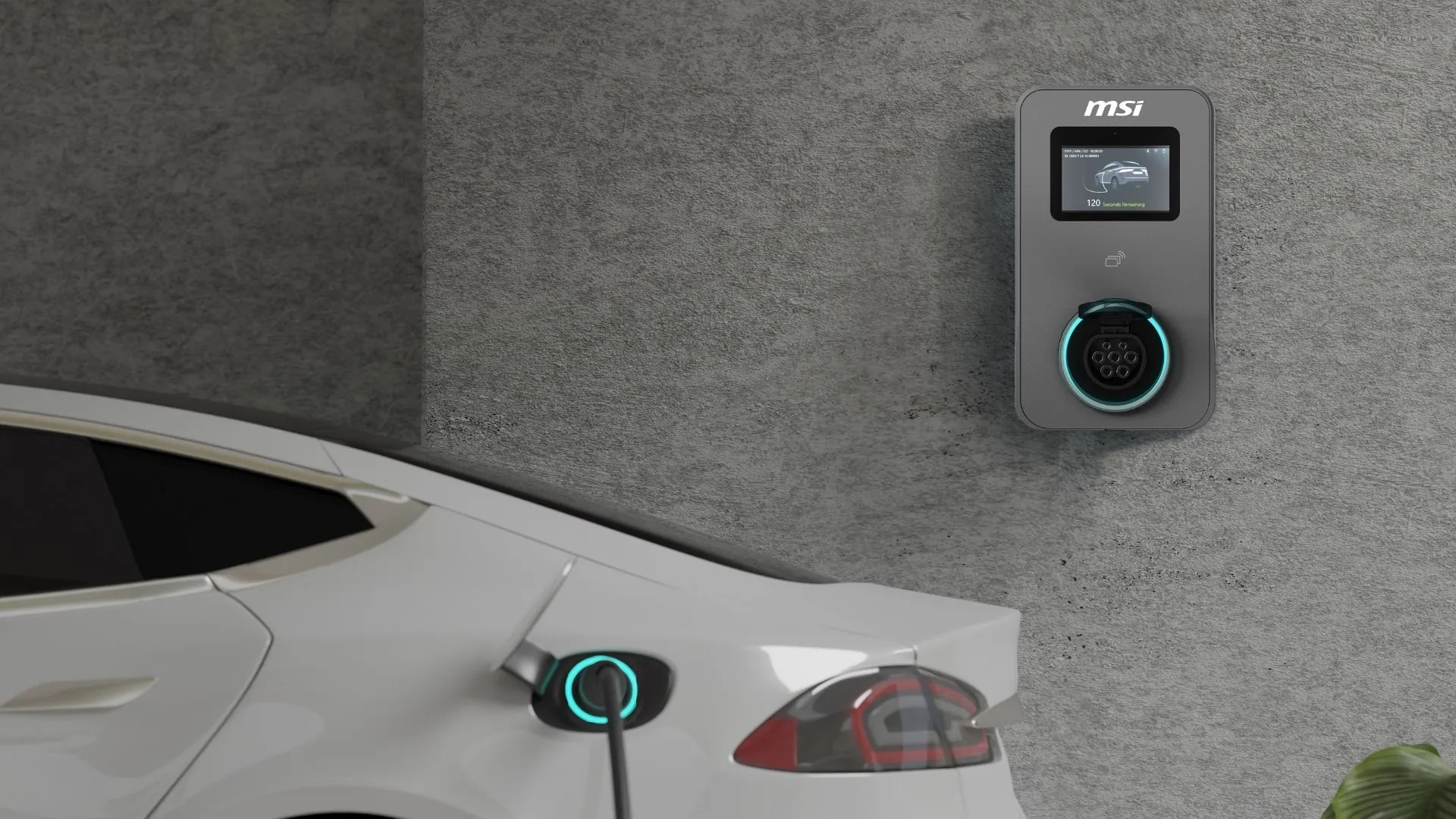
MSI has launched its EV charging range in the UK, including the £189 EZgo portable charger and two home wallboxes priced from £449. It is an unexpected name to see in the home-charging market if you mainly associate MSI with gaming laptops, graphics cards and PC components, but power electronics are hardly a completely alien business for the company.
The more interesting question is whether a recognisable technology brand can persuade EV owners to buy something that becomes part of their house rather than something that sits on a desk. A charger is infrastructure. It needs to be safe, reliable, supported for years and compatible with the way you actually charge your car, which means the spec sheet is only part of the story.
What EV chargers is MSI selling in the UK?
The launch range covers three obvious use cases. The EZgo is a portable Type 2 charger that plugs into a normal UK socket and can deliver up to 3kW. The Eco Life Max and Eco Premium Max are fixed wallboxes aimed at normal home or workplace charging, with versions capable of 7kW on single-phase supplies and up to 22kW where three-phase power is available.
| Model | Reported UK price | Charging power | Best suited to |
| MSI EZgo | £189 | Up to 3kW | Portable or occasional charging |
| Eco Life Max | £449 | Up to 7kW single-phase / 22kW three-phase | Home wallbox charging |
| Eco Premium Max | £599 | Up to 7kW single-phase / 22kW three-phase | Home or shared charging with display and extra controls |
Those launch prices come from ElectricDrives' UK report and may change, so I would still check the live retail price before buying. MSI's own product pages are more useful for understanding the hardware and features.
What does the MSI EZgo portable charger do?
The EZgo uses a standard 13A UK plug on one end and a Type 2 connector on the other, with a 7.5-metre cable and a small 1.8-inch display. MSI rates it at up to 3kW and includes Bluetooth connectivity so charging schedules and history can be managed through its app.
At around 3kW it is much slower than a normal 7kW home wallbox, but that is not really the point. A portable charger can be useful at a holiday cottage, when visiting family or as an emergency backup, provided the electrical supply is suitable and the charger is used in line with the manufacturer's instructions.
Should you use a three-pin EV charger every day?
I would see the EZgo as a backup or occasional solution rather than my first choice for everyday home charging. A dedicated wallbox is faster and can be installed on a circuit designed specifically for sustained EV charging, with the protective equipment and load management appropriate to the property.
That does not make portable charging inherently bad. It simply means a normal socket and the wiring behind it were not installed with hours of continuous high-load EV charging in mind. If you are going to rely on one regularly, the condition of the socket and electrical installation matters far more than the convenience of being able to plug in anywhere.
What is the difference between Eco Life Max and Eco Premium Max?
Both are proper fixed EV chargers and are available in configurations up to 7kW on a normal single-phase domestic supply or 22kW on a three-phase supply. The Premium model adds a five-inch screen and additional authentication features, while the Life version uses a simpler LED-based interface.
For a typical UK house, 7kW is the number that matters because most homes do not have three-phase power. A 22kW figure can look impressive in a brochure, but the car must also support that AC charging rate and the property needs the electrical supply to deliver it. For many drivers, a well-managed 7kW unit charging overnight is all they will ever need.
What would I check before buying an MSI charger?
I would start with installation rather than the charger itself. Check who will fit it, whether the installer understands the product, what happens if it develops a fault and how long the warranty and support arrangements last. I would also check smart-tariff compatibility, load balancing, solar integration if you have panels, cable length and whether you prefer a tethered cable or a socketed unit.
Grant eligibility is another area where I would verify the exact model against the current government list rather than assuming every product in a range qualifies. Rules and approved-model lists can change, and the saving is only useful if your household and the particular charger both meet the scheme requirements.
Is MSI a credible EV charging brand?
It is too early for me to judge the UK ownership experience because these products are new here, but MSI is not a start-up appearing from nowhere. The company already works extensively with power supplies, thermal management and connected hardware, and the charger specifications show some sensible thinking around weather resistance, scheduling and user controls.
What I would not do is buy purely because I recognise the badge. A wallbox may stay attached to your home for longer than you keep the car currently plugged into it, so aftersales support, software longevity and installer knowledge matter just as much as the launch price.
Would I buy one?
The EZgo is the product I find most immediately interesting because £189 for a branded portable charger makes it easy to understand as a useful backup. The wallboxes look competitively priced too, but I would want to see how the UK installer network, app support and long-term service develop before choosing one over an established home-charging brand.
More competition is still good news. Home charging does not need to be glamorous, but it does need to become cheaper and easier to understand. If MSI can bring some of the aggressive pricing and feature competition we see in consumer electronics into EV charging without compromising support, that could be genuinely useful.