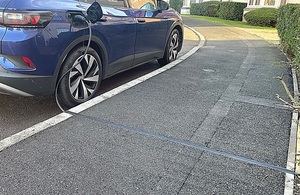
From 21 October 2026, households in England no longer need planning permission for qualifying cross-pavement EV charging installations, with the government estimating that the change could save drivers up to £300. It sounds like a small piece of planning reform, but for people who park on the street it removes one of the extra costs and administrative hurdles that can make home EV charging feel unnecessarily difficult.
The change does not mean everybody can simply trail a cable across the pavement, and it does not guarantee that a charging channel can be installed outside every home. What it does is remove the need for a separate planning application in qualifying cases, making properly designed cross-pavement solutions easier to pursue.
What is cross-pavement EV charging?
Cross-pavement charging normally uses a channel, gully or similar installation that allows a charging cable to pass safely between a home and a car parked at the kerb without leaving a loose cable lying across the footway. The aim is to give people without a driveway access to domestic electricity while keeping the pavement usable for pedestrians, wheelchairs and pushchairs.
That distinction matters. Running an ordinary extension lead or loose charging cable across a pavement can create a trip hazard and may breach local rules. A purpose-built system is intended to manage the cable safely and consistently, often as part of a local authority-approved approach.
What has actually changed?
The government has changed planning rules in England so qualifying cross-pavement EV charging installations can be treated as permitted development rather than requiring a separate planning application. The Department for Transport says avoiding that application can save households up to £300.
This is an England-specific planning change. Scotland, Wales and Northern Ireland have their own planning systems, so I would not assume the same rule applies elsewhere in the UK. Even in England, removing planning permission does not automatically remove every other consent or practical requirement.
Do you still need permission from the council?
Potentially, yes. The pavement is part of the highway rather than your private driveway, and local authorities can have their own approved products, installation processes and licensing arrangements. If you rent or are a leaseholder, you may also need permission from a landlord or freeholder before altering the property or installing charging equipment.
The easiest way to think about the reform is that one layer of red tape has been removed, not that the pavement outside your home has suddenly become private land. I would speak to the council before paying for equipment and make sure the installer understands the local scheme.
How much can home charging save compared with public charging?
The financial argument for home charging can be substantial. The government says some drivers can charge for as little as 2p per mile on the right domestic tariff and estimates potential running-cost savings of up to £1,750, although your actual figure depends on the car, tariff, mileage and the public chargers you would otherwise use.
That is why cross-pavement solutions matter beyond convenience. Drivers with driveways have long been able to benefit from cheap overnight electricity, while people who park on the street can end up paying considerably more at public chargers. Giving more households access to domestic tariffs helps close that gap.
What should you check before installing a cross-pavement charger?
First, check whether your local authority supports cross-pavement charging and what products or installers it accepts. Then confirm whether you have any landlord or freeholder permissions to deal with, whether the parking arrangement outside your home is suitable and whether the proposed system can be installed without obstructing the highway.
I would also think about something less obvious: you do not own the parking space outside your house simply because the cable reaches it. If on-street parking is heavily contested, a charging channel may be technically possible but not always convenient. The best installations will be in places where the car can usually park close enough to use the connection without creating conflict with neighbours or other road users.
Does this make owning an EV without a driveway easy?
Not universally, but it makes it easier for a meaningful group of people. I have a separate guide to owning an electric car without a driveway covering public charging, workplace charging and other options, because no single solution works for every street.
Cross-pavement charging is particularly attractive when you have reliable parking near the house and the local authority already has a clear installation process. In that situation, removing the planning application should make the whole thing cheaper and less intimidating.
Why this matters for EV adoption
One of the easiest mistakes in the EV debate is assuming everybody can fit a wallbox next to a driveway. A huge number of British homes simply do not have off-street parking, and those drivers can face higher charging costs even though they may be driving exactly the same car as somebody living a few streets away.
Infrastructure policy needs to deal with that inequality if electric cars are going to feel like a realistic mainstream choice. Removing a £300 planning hurdle is not transformative on its own, but combined with clearer council processes and more cross-pavement installations it could make domestic charging available to households that have effectively been locked out of it.
My view
I think this is a sensible change because it removes paperwork without pretending the safety and highway issues disappear. Cross-pavement charging should be treated as normal household infrastructure where it can be installed safely, not as an unusual planning project that requires people to navigate a complicated process before they even know whether it is affordable.
The next challenge is consistency. If one council makes installation straightforward and another has no clear process, the experience will still depend heavily on your postcode. The planning change is useful, but the real test is whether local authorities can turn it into something ordinary drivers can actually access.